If your child is appearing for a scholarship exam syllabus class 4, the syllabus is probably the first thing you searched for, and for good reason. Knowing exactly what to prepare saves weeks of guesswork and stops your child from wasting time on topics that never show up in the actual paper. This guide breaks down the full scholarship exam syllabus for Class 4, subject by subject, along with the exam pattern and a preparation plan that won’t burn your child out before exam day.
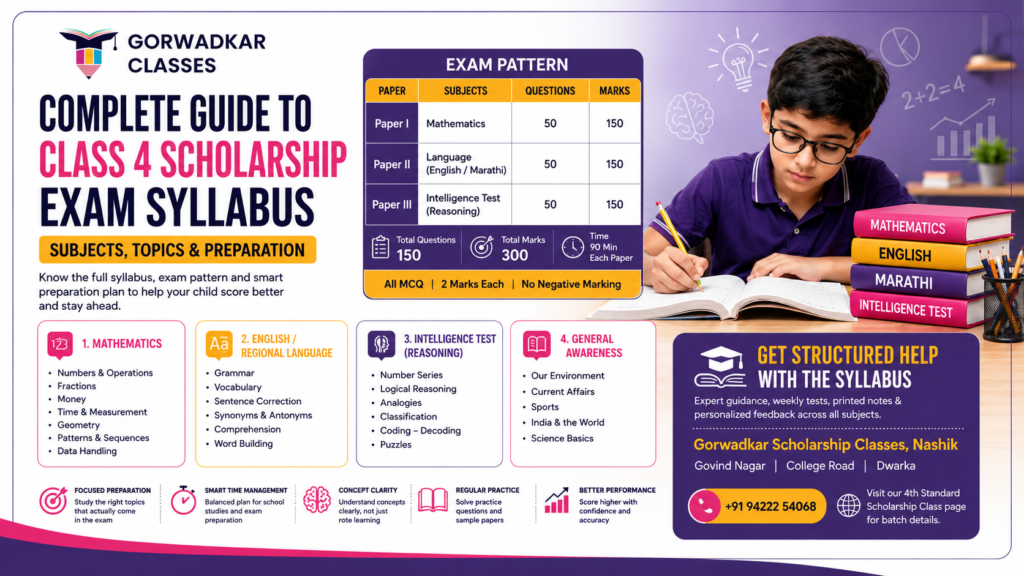
Table of Contents
- What Is a Scholarship Exam Syllabus Class 4?
- Types of Class 4 Scholarship Exams
- Why the Syllabus Matters More Than the Marks
- Full Scholarship Exam Syllabus for Class 4
- Typical Exam Pattern and Marking Scheme
- Benefits of Appearing for the Exam
- How to Prepare Without Overloading Your Child
- A Sample Weekly Study Plan
- Common Mistakes to Avoid
- Choosing the Right Study Material
- Frequently Asked Questions
What Is a Scholarship Exam Syllabus Class 4 ?
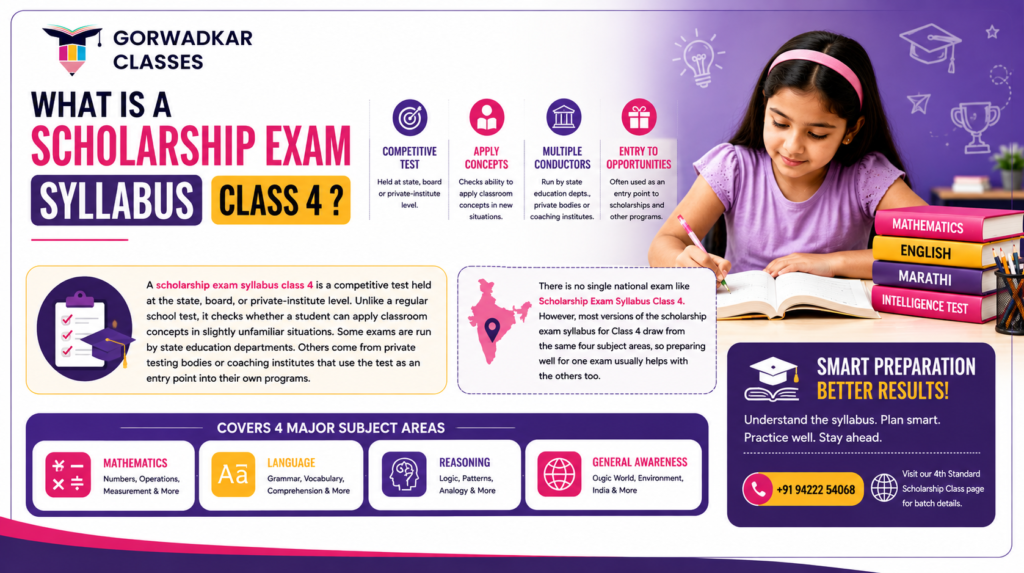
A scholarship exam syllabus class 4 is a competitive test held at the state, board, or private-institute level. Unlike a regular school test, it checks whether a student can apply classroom concepts in slightly unfamiliar situations. Some exams are run by state education departments. Others come from private testing bodies or coaching institutes that use the test as an entry point into their own programs.
There is no single national exam like Scholarship Exam Syllabus Class 4. However, most versions of the scholarship exam syllabus for Class 4 draw from the same four subject areas, so preparing well for one exam usually helps with the others too.
Types of Class 4 Scholarship Exams
Before diving into the syllabus, it helps to know that “Scholarship Exam Syllabus Class 4” is an umbrella term. Three broad categories exist in India, and the syllabus can shift slightly depending on which one your child is registered for.
State government exams. Several state education departments run their own primary-level scholarship or talent search exams, usually aimed at government and government-aided school students. These follow the state board curriculum closely.
Private institute exams. Many coaching institutes and educational trusts run their own scholarship or talent search tests open to students from any school board. These often add an extra reasoning or aptitude component beyond the regular syllabus.
National-level talent search programs. A handful of trusts and foundations run pan-India scholarship exams for primary school students, offering cash awards or fee waivers to top scorers.
Always confirm which category your exam falls under before picking study material, since the weightage between subjects can differ between the three.
Why the Syllabus Matters More Than the Marks
Parents often ask how many extra hours their child needs to study for this Scholarship Exam Syllabus Class 4 exam. Honestly, the answer is fewer hours than most people expect. A ten-year-old does not need extra tuition stacked onto an already full school day. What actually helps is knowing which topics will appear, so study time goes toward the right material instead of random worksheets.
This also explains why strong school performers sometimes struggle with scholarship exams. Regular school tests check whether a topic was taught and understood. Scholarship exams go one step further and test whether a child can apply that same concept when the question is worded differently or wrapped inside a reasoning puzzle.
Full Scholarship Exam Syllabus for Class 4
Most Scholarship Exam Syllabus for Class 4 are built around four broad subjects. Below is a subject-wise breakdown of what usually appears.
1. Mathematics
Mathematics typically carries the highest weight in the scholarship exam syllabus for Class 4. Expect questions from:
- Place value and face value of numbers, up to five or six digits
- Addition, subtraction, multiplication, and division of large numbers
- Fractions: comparing, adding, and subtracting simple fractions
- Money: buying, selling, and converting rupees to paise
- Time: reading clocks in both 12-hour and 24-hour formats
- Measurement: length, weight, and capacity, including basic unit conversions
- Shapes and geometry: identifying 2D and 3D shapes, plus perimeter and area of simple figures
- Patterns and number sequences
- Data handling: pictographs, bar graphs, and simple tables
Word problems appear across every topic rather than as a separate category. Most exams want to see whether a child can turn a real-life situation into a working calculation.
2. English or Regional Language
Language sections test grammar and comprehension together, not just vocabulary. Common topics include:
- Tenses, singular and plural forms, articles, adjectives, and adverbs
- Sentence correction and spotting grammatical errors
- Synonyms, antonyms, and “one word for many words” questions
- Simple idioms and phrases
- Word building and sentence completion
- Reading comprehension passages with short follow-up questions
- Rearranging jumbled words or sentences
If the exam runs in a regional language, such as Marathi in Maharashtra’s scholarship exam, the same categories apply, often alongside a separate English paper.
3. Intelligence Test or Mental Ability
This section separates scholarship exams from ordinary school tests, and it is usually the toughest without practice. It covers:
- Verbal reasoning and analogies
- Number series and pattern completion
- Classification, or finding the odd one out
- Coding-decoding
- Simple puzzles and logical riddles
- Similar-sounding words used in sentence formation
None of this needs advanced concepts. It needs exposure. A child who has never seen a coding-decoding question before will freeze on it during the exam, even though the logic behind it is simple once explained.
4. Environmental Studies or General Awareness
This section may stand alone or sit inside the language paper, depending on the exam. Typical areas include:
- The human body: basic organs and their functions
- Plants and animals: life cycles, habitats, and basic classification
- Seasons, festivals, and their connection to daily life
- Maps and directions
- Transport and communication
- Community life and basic civic sense
How the Syllabus Differs From the Regular School Curriculum
Parents often assume the scholarship exam syllabus for Class 4 is a separate subject altogether. It isn’t. It borrows directly from the school curriculum, then adds two layers on top.
The first layer is depth. A school test might ask a student to add two four-digit numbers. A scholarship exam might wrap that same addition inside a word problem about splitting money between three people, with an extra step hidden in the wording.
The second layer is the reasoning section itself, which most schools simply don’t teach as a formal subject. This is the single biggest reason students find the exam harder than expected, even when they know every concept from their textbook.
Once a child understands that the syllabus isn’t “extra,” just “deeper,” the exam becomes far less intimidating.
Typical Exam Pattern and Marking Scheme
Patterns vary between exams, but most Class 4 scholarship exams follow a structure close to this:
| Section | Approx. Weight | Question Type |
|---|---|---|
| Mathematics | 35-40% | Multiple choice or short answer |
| Language | 25-30% | Multiple choice, comprehension |
| Intelligence Test | 20-25% | Multiple choice |
| EVS / General Awareness | 10-15% | Multiple choice |
Most papers run for 60 to 90 minutes in an objective, multiple-choice format, which allows quick and fair evaluation across a large number of candidates. Some exams split the paper into two parts with a short break in between, since attention at this age tends to drop after roughly 45 minutes of continuous focus.
Benefits of Appearing for the Exam
Even outside the prize money or certificate, the scholarship exam syllabus for Class 4 pushes a child to build habits that pay off well beyond this one test.
- Early exposure to competition. Students learn to perform under time pressure long before board exams or entrance tests arrive later in their academic life.
- Deeper concept clarity. Preparing for reasoning and application-based questions encourages real understanding instead of rote memorisation.
- Stronger exam temperament. Sitting through a timed, formal paper at a young age builds comfort with exam settings, which helps in every test that follows.
- Recognition and confidence. A good rank or scholarship award gives a genuine confidence boost at an age when that motivation carries forward for years.
How to Prepare Without Overloading Your Child
The scholarship exam syllabus for Class 4 looks lengthy once it’s all listed out. In reality, it overlaps closely with what a Class 4 student already learns in school. The real gap is exposure to the exam format, not missing knowledge. A few habits make a genuine difference.
Practice with timed sets instead of endless worksheets. Ten questions solved within a five-minute limit teach more about exam pace than fifty questions solved without a clock.
Read each question twice before answering. Scholarship exams often word questions to test real understanding rather than pattern recognition. A quick second read catches most careless errors.
Treat mental ability as its own subject. Since schools rarely teach it directly, this section needs dedicated practice time rather than being left for the final week before the exam.
Use previous years’ papers whenever they’re available. Nothing reveals the real difficulty level and question style better than an actual past paper from the same exam.
Keep each session short. Twenty to thirty minutes a day, four or five days a week, across two or three months, works better than one exhausting week of cramming right before the test.
A Sample Weekly Study Plan
A simple, repeatable weekly routine works better than an intense, irregular one. Here’s a plan many parents find manageable alongside regular school homework:
| Day | Focus Area | Time |
|---|---|---|
| Monday | Mathematics practice set | 25 minutes |
| Tuesday | Language and grammar | 25 minutes |
| Wednesday | Mental ability puzzles | 25 minutes |
| Thursday | EVS or general awareness | 20 minutes |
| Friday | Mixed revision set | 25 minutes |
| Saturday | Timed mock section | 30 minutes |
| Sunday | Rest or light reading | — |
Adjust the order and duration based on which subject your child finds hardest, and increase the mock exam frequency as the actual test date gets closer.
Common Mistakes to Avoid
A few patterns repeat often among Class 4 scholarship exam candidates.
- Starting too late. Because the syllabus overlaps with the school curriculum, parents sometimes assume no separate preparation is needed. By the time they start, there isn’t enough time left to build speed and accuracy.
- Ignoring the reasoning section. Since schools don’t teach it directly, this is the one area students walk into the exam least prepared for.
- Buying the wrong study material. Not every scholarship exam guidebook matches the syllabus of the specific exam your child is registered for. Cross-checking the syllabus before buying material saves both time and money.
- Skipping mock exams. A child who has never sat through a full-length timed paper at home is more likely to lose focus or rush through the real one.
Choosing the Right Study Material
Since the scholarship exam syllabus for Class 4 differs slightly from one exam to another, get the official syllabus notification directly from the conducting body before buying any guidebook. Local coaching institutes that specifically prepare students for the exam in question are usually a safer choice than generic scholarship workbooks, since their material is built around the actual paper pattern rather than an average of several different exams.
When comparing guidebooks, check the publication year and whether the content matches the current syllabus notification. Exam bodies occasionally revise their syllabus, add new topics, or drop older ones, and an outdated guidebook can send your child’s preparation in the wrong direction. It’s worth spending an extra few minutes cross-checking the table of contents against the official syllabus before you commit to buying a full set of books.
[Internal link suggestion: Link this phrase to your site’s “Class 4 Scholarship Exam Sample Papers” page, if you have one]
[External link suggestion: Link to the official state education board or exam conducting body’s syllabus PDF, if publicly available]
Frequently Asked Questions
Is the Class 4 scholarship exam syllabus the same as the school syllabus? Largely yes, but scholarship exams add a mental ability or reasoning section that schools don’t teach directly, and they test familiar concepts at a slightly higher difficulty level.
How many months of preparation does a Class 4 student need? Two to three months of steady, short daily practice is usually enough, since the exam builds on what’s already being taught in school that year.
Which subject carries the most weight in the syllabus? Mathematics typically holds the largest share of questions, followed by language, and then the intelligence test section.
Do all scholarship exams for Class 4 follow the same syllabus? No. State-run exams, board-level exams, and private institute exams each set their own syllabus and pattern, though the core subjects overlap significantly across all of them.
What is the best way to start preparing for the Class 4 scholarship exam syllabus? Start by getting the official syllabus for the specific exam your child is registered for, then build a short daily practice routine around each of the four subject areas listed above.
Is there negative marking in Class 4 scholarship exams? This depends entirely on the conducting body. Many primary-level scholarship exams avoid negative marking to encourage younger students to attempt every question, but always check the specific exam’s rulebook before assuming either way.
Can a student prepare for the scholarship exam syllabus without joining a coaching class? Yes. With the official syllabus, a set of past papers, and a consistent short daily routine at home, most Class 4 students can prepare well without formal coaching, though guided practice helps if the reasoning section feels difficult.
Final Thoughts
The scholarship exam syllabus for Class 4 isn’t designed to trip students up with unfamiliar material. It draws from the same subjects taught in school, tested with a bit more depth and a reasoning section added in. A student who practices consistently, understands the exam pattern, and spends focused time on mental ability questions has a genuine shot at doing well, without turning the weeks before the exam into extra stress for the whole family.
Word problems show up throughout this section rather than as a separate category, since most exams prefer to test whether a child can translate a real-life situation into a calculation.
2. English or Language
Language sections tend to test both grammar and comprehension rather than just vocabulary lists. Expect:
- Grammar basics: tenses, singular and plural forms, articles, adjectives, and adverbs
- Sentence correction and identifying grammatical errors
- Synonyms, antonyms, and “one word for many words” type questions
- Simple idioms and phrases
- Word building and sentence completion
- Reading comprehension passages followed by short questions
- Rearranging jumbled words or sentences
If the exam is conducted in a regional language, such as Marathi in Maharashtra’s scholarship exam, the same categories apply but in that language, alongside a separate English section in many cases.
3. Intelligence Test or Mental Ability
This section is what separates scholarship exams from ordinary school tests, and it’s usually the one students find hardest without practice. It covers:
- Verbal reasoning and analogies
- Number series and pattern completion
- Classification (finding the odd one out)
- Coding-decoding
- Simple puzzles and logical riddles
- Finding similar-sounding words and forming sentences with them
None of this requires advanced concepts. It requires exposure. A child who has never seen a coding-decoding question before will freeze on it in the exam hall, even if the underlying logic is simple once explained.
4. Environmental Studies or General Awareness
Depending on the exam, this section may appear as a standalone subject or folded into the language paper. Typical areas include:
- The human body: basic organs and their functions
- Plants and animals: life cycles, habitats, and basic classification
- Seasons, festivals, and how they connect to daily life
- Maps and directions
- Transport and communication
- Community life and basic civic sense
A Typical Exam Pattern
Exact patterns vary by exam, but a general structure looks something like this:
| Section | Approx. Weight | Question Type |
| Mathematics | 35-40% | Multiple choice / short answer |
| Language | 25-30% | Multiple choice, comprehension |
| Intelligence Test | 20-25% | Multiple choice |
| EVS / General Awareness | 10-15% | Multiple choice |
Most Class 4 scholarship exams run for 60 to 90 minutes and use an objective, multiple-choice format so results can be evaluated quickly and fairly across a large number of students. Some exams split the paper into two parts, with a short break in between, since attention spans at this age drop off after about 45 minutes of continuous focus.
How to Prepare Without Overloading a Class 4 Student
The syllabus above can look like a lot when it’s all listed out, but it maps closely to what a Class 4 student is already learning in school. The gap is usually in exposure to the exam format, not in the underlying knowledge. A few things genuinely move the needle:
Practice with timed sets, not endless worksheets. Ten questions done under a five-minute limit teaches more about exam pace than fifty questions done at leisure over an hour.
Read the question twice before answering. Scholarship exam questions are often worded to test whether a child actually understood the problem or just recognized a familiar pattern. A quick second read catches most careless mistakes.
Treat the mental ability section as its own subject. Since it isn’t taught directly in school, it needs dedicated practice time rather than being left for the last week before the exam.
Use previous years’ papers if they’re available. Nothing shows the real difficulty level and question style better than an actual past paper from the same exam.
Keep sessions short. Twenty to thirty minutes a day, four or five days a week, over two or three months, beats a single exhausting week of cramming.
Common Mistakes Parents and Students Make
A few patterns show up again and again with Class 4 scholarship exam candidates:
- Starting too late. Because the syllabus overlaps with school curriculum, parents assume no separate preparation is needed until closer to the date, then find there isn’t enough time to build speed and accuracy.
- Ignoring the reasoning section. Since it isn’t part of the school syllabus, it’s the one area students are least prepared for on exam day.
- Over-preparing with unrelated material. Not every scholarship exam guidebook matches the syllabus of the specific exam a child is taking. Cross-checking the syllabus before buying study material saves both time and money.
- Skipping mock exams. A child who has never sat through a full-length timed paper at home is likely to lose focus or rush through the real one.
Choosing the Right Study Resources
Since the syllabus differs slightly from one scholarship exam to another, it helps to get the official syllabus document or notification directly from the conducting body before picking a guidebook. Local coaching institutes that specifically prepare students for the exam in question are usually a safer bet than generic “scholarship exam” workbooks, since their material is built around the actual paper pattern rather than a broad average of several exams.
Frequently Asked Questions
Is the Class 4 scholarship exam syllabus the same as the school syllabus? Largely yes, but scholarship exams add a mental ability or reasoning section that isn’t part of regular school teaching, and they test the same concepts at a slightly higher difficulty.
How many months of preparation does a Class 4 student need? Two to three months of steady, short daily practice is usually enough, since the exam builds on what’s already being taught in school that year.
Which subject carries the most weight? Mathematics typically has the largest share of questions, followed by language and then the intelligence test section.
Do all scholarship exams for Class 4 follow the same pattern? No. State-run exams, board-level exams, and private institute exams each set their own syllabus and pattern, though the core subjects overlap significantly.
Final Thoughts
The scholarship exam syllabus for Class 4 isn’t designed to trip students up with unfamiliar material. It’s built around the same subjects taught in school, tested with a bit more depth and a reasoning section thrown in. A student who practices consistently, understands the exam pattern, and spends focused time on mental ability questions has a real shot at doing well, without turning the run-up to the exam into extra stress for the whole family.