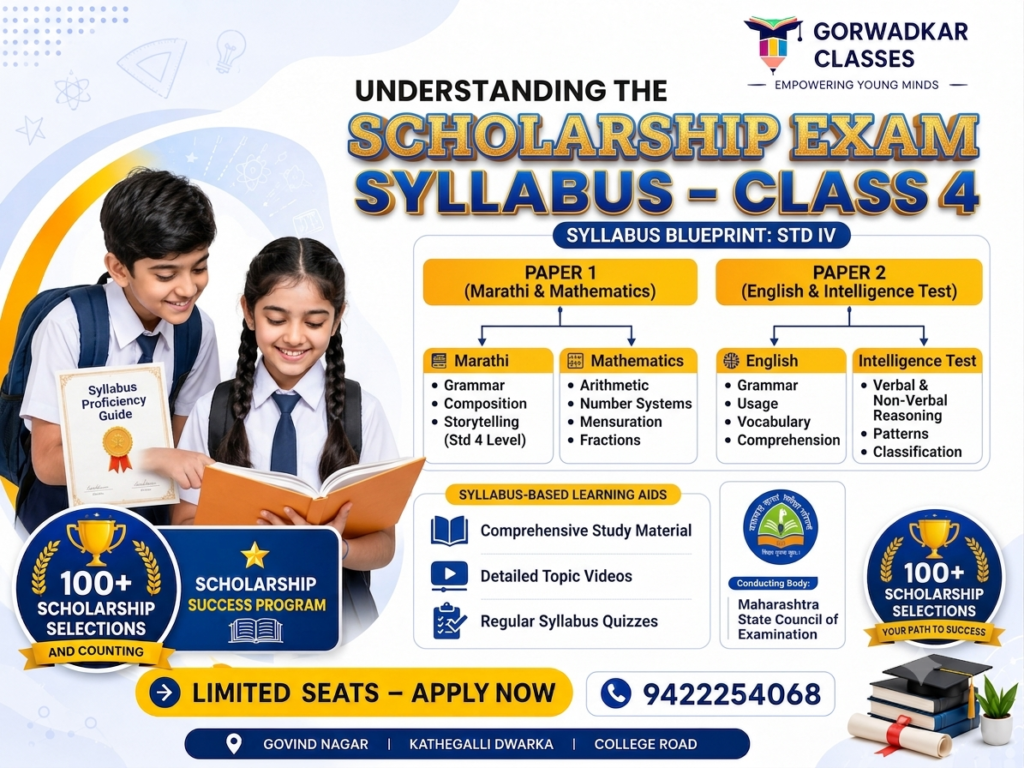
Ask any parent what worries them most about the Class 4 scholarship exam, and it’s usually the same thing: nobody’s entirely sure what to study. The scholarship exam syllabus Class 4 isn’t a single list handed out at school — it’s spread across two papers, four subjects, and a reasoning section most children have never formally studied. This piece breaks the whole thing down section by section, so you know exactly what your child needs to cover before the exam.
Exam Pattern First: Why the Syllabus Is Split the Way It Is
Before getting into topics, it helps to see the structure the syllabus sits inside. The MSCE Class 4 scholarship exam runs as two papers on the same day, each 90 minutes long:
| Paper | Subjects | Questions | Marks |
|---|---|---|---|
| Paper I | First Language + Mathematics | 25 + 50 = 75 | 150 |
| Paper II | Third Language + Intelligence Test | 25 + 50 = 75 | 150 |
That’s 300 marks total, all multiple-choice, 2 marks per question, with no negative marking — so every question is worth attempting. With 75 questions in 90 minutes, students get roughly 1.2 minutes per question, which is exactly why speed matters as much as accuracy in this exam.
Notice that Mathematics and the Intelligence Test carry the heavier question count in each paper (50 out of 75). Those two sections alone account for two-thirds of the total marks, which should shape how study time gets divided.
Paper I: First Language (Marathi)
This section tests real command of the language, not textbook memorization. The core areas are:
- Grammar – tenses, sentence structure, parts of speech
- Vocabulary – synonyms, antonyms, word meanings
- Word formation – prefixes, suffixes, compound words
- One-word substitution and idiomatic usage
- Reading comprehension – short passages followed by questions
Most of this overlaps with the regular school syllabus, but the exam tests it faster and with less context than a school test would. Reading a short passage and answering timed questions on it, a few times a week, is the single most useful habit to build here.
Paper I: Mathematics
This is the single largest section by question count, so it deserves proportionate study time. Core topics include:
- Number work – reading and writing numbers, place value, expanded form
- Operations – addition, subtraction, multiplication, division (including multi-step problems)
- Fractions – simple fractions and decimal fractions
- Measurement – length, mass, capacity, time, and money
- Basic geometry – shapes, lines, and simple properties
The exam rarely asks for a harder formula than a child already knows – it asks the same basic operation inside an unfamiliar word problem. That’s the skill worth practicing: recognizing what a question is really asking before doing the calculation.
Paper II: Third Language (English)
For most Nashik students, English sits as the third language in this exam. The syllabus mirrors the Marathi section in structure but at a level appropriate for a third language:
- Grammar basics – tenses, articles, simple sentence construction
- Vocabulary – common words, synonyms, antonyms
- Reading comprehension – short passages with direct and inferential questions
- Basic composition – picture-based or short-answer questions
Daily short practice – ten to fifteen minutes of reading and vocabulary – tends to work better here than occasional long study sessions, simply because language retention builds gradually.
Paper II: Intelligence Test
This is the section with no direct school-subject equivalent, and it’s usually where the exam separates well-prepared students from the rest. It covers:
- Pattern and series completion
- Classification
- Coding-decoding
- Simple logical reasoning and analogies
- Basic problem-solving puzzles
Because none of this appears in regular textbooks, it needs to be treated as its own subject with its own practice schedule – not squeezed in during the last few weeks before the exam. Children who start reasoning practice early tend to build genuine comfort with the format rather than memorized tricks that fall apart under unfamiliar questions.
How to Use This Syllabus Practically
Once the syllabus is broken down like this, a study plan more or less writes itself:
- Weight your study time to match the marks – Mathematics and the Intelligence Test deserve more sessions per week than the language papers, since together they carry 200 of the 300 marks.
- Practice under real time pressure – with roughly a minute per question, timed practice matters as much as knowing the content.
- Treat the Intelligence Test as a standalone subject from day one, not a section to “pick up” later.
- Revisit comprehension and vocabulary regularly for both language papers, since these build slowly rather than through one-time memorization.
Getting Structured Help With the Syllabus
Covering this syllabus properly – four subjects, two exam papers, and a reasoning section with no school textbook to lean on – is a lot for a family to manage entirely on their own alongside regular schoolwork. This is usually where a structured coaching class earns its place: breaking the syllabus into a weekly plan, running mock tests that mirror the real MSCE pattern, and flagging exactly which topics a child is weak on before the gap becomes hard to close.
Gorwadkar Scholarship Classes in Nashik runs its 4th standard batch around this exact syllabus – dedicated coverage for Marathi, Mathematics, English, and the Intelligence Test, with weekly tests and printed notes, across its Govind Nagar, College Road, and Dwarka centers. If you’d like help mapping this syllabus to a term-wise schedule for your child, you can call or WhatsApp +91 94222 54068, or check the 4th Standard Scholarship Class page for batch details.
Frequently Asked Questions
How many subjects are in the Class 4 scholarship exam syllabus? Four in total: First Language (Marathi), Mathematics, Third Language (English), and the Intelligence Test – split across two papers.
Which section carries the most marks? Mathematics and the Intelligence Test each contribute 50 questions (100 marks) out of the 150 marks per paper, making them the heaviest-weighted sections.
Is there negative marking in the exam? No. All questions are multiple-choice with no penalty for wrong answers, so every question is worth attempting.
Does the syllabus follow the regular school textbook? Mostly, for Marathi, Mathematics, and English. The Intelligence Test is the exception – it isn’t part of the standard school syllabus and needs separate preparation.
How much time does a student get per question? Roughly 1.2 minutes per question, based on 75 questions in a 90-minute paper – which is why timed practice matters as much as content revision.
Final Word
The Class 4 scholarship syllabus looks intimidating mainly because it’s scattered across sources – a bit from the school textbook, a bit from past papers, and an entire reasoning section with no textbook at all. Once it’s laid out clearly like this, it becomes a checklist rather than a mystery. Start early, weight your effort toward Mathematics and the Intelligence Test, and revisit the language sections consistently rather than in one final push.