Most parents ask the same question once they realize the scholarship exam has moved down to 4th standard: how to prepare for scholarship exam Class 4 when the exam window is now a full year earlier than it used to be? Your child has never seen a paper like this before, and the syllabus stretches across two subjects plus a reasoning section that isn’t taught in regular school.
The good news is that a 9-year-old doesn’t need a complicated study system. They need a routine that’s consistent, a clear sense of which topics are weak, and enough practice under real exam conditions that the paper doesn’t feel unfamiliar on the day. Here’s how to build that.

Start by Understanding What the Exam Actually Tests
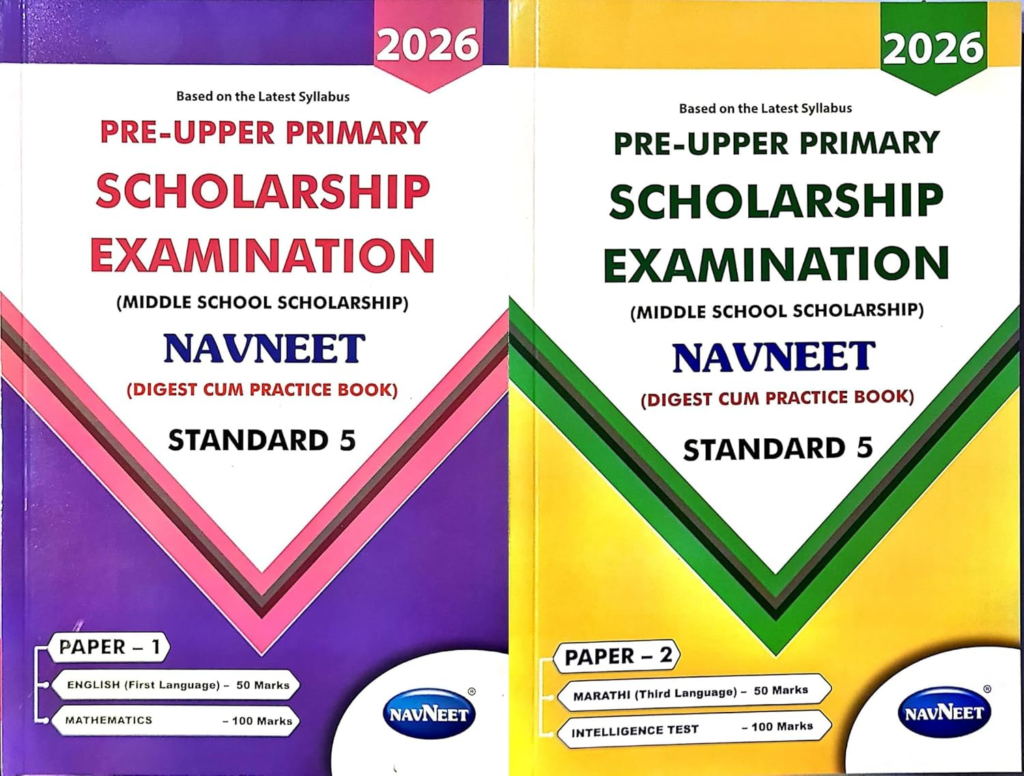
Before making a study plan, it helps to know the shape of the paper. The Class 4 scholarship exam has two parts:
- Paper 1 – First Language (Marathi) and Mathematics
- Paper 2 – Third Language (English) and an Intelligence Test
The first three sections map fairly closely to school subjects, just at a faster pace and greater depth. The Intelligence Test is the odd one out – it covers pattern recognition, logical reasoning, and problem-solving that a regular school textbook barely touches. This is usually the section that decides whether a child clears the exam or just comes close, so it deserves separate, dedicated practice rather than being squeezed in at the end.
Build a Realistic Weekly Timetable
A child in 3rd or 4th standard shouldn’t be doing marathon study sessions. What works better is short, focused blocks spread across the week:
- 4–5 days a week, 45–60 minutes per session, rather than long weekend cramming
- Rotate subjects rather than sticking to one for days at a time – Marathi one day, Maths the next, reasoning mixed in throughout
- Keep one day fully free of scholarship prep so the exam doesn’t start to feel like a burden
The goal isn’t to maximize hours. It’s to keep the material fresh in a way that daily school homework alone won’t manage.
Go Subject by Subject
Marathi (First Language)
Focus on grammar rules, comprehension passages, and vocabulary rather than pure memorization. Reading a short Marathi passage aloud and answering questions on it, a few times a week, builds the comprehension speed the exam actually tests.
Mathematics
Scholarship-level Maths questions are rarely about harder formulas – they’re about applying basic concepts to unfamiliar situations. Word problems, number patterns, and multi-step calculations deserve more practice time than straightforward arithmetic drills.
English (Third Language)
Keep this to grammar fundamentals, simple comprehension, and vocabulary building. Since English is the third language for most students, short daily practice beats occasional long sessions.
Intelligence Test
This is the section to treat as a separate subject, not an afterthought. Series completion, classification, coding-decoding, and simple logical puzzles should get their own slot in the weekly timetable – ideally the first thing introduced, since it takes the longest to get comfortable with.
Use Mock Tests the Right Way
Solving past papers and mock tests matters less for the score itself and more for what it reveals. After each mock test:
- Mark which questions were wrong, not just how many
- Sort those into “didn’t know the concept” versus “knew it but made a careless mistake”
- Spend the next few days’ study sessions specifically on that weak list, not on topics your child already handles well
Doing this consistently is usually what separates steady improvement from a score that plateaus a few weeks before the exam.
Common Mistakes to Avoid
- Starting too late. With the exam now at Class 4 instead of Class 5, a 3rd-standard start gives far more breathing room than waiting until a few months before the paper.
- Ignoring time management. The scholarship paper is timed tightly. Practicing under a clock matters as much as knowing the material.
- Treating the Intelligence Test as unteachable. It isn’t. It just needs targeted practice, the same as any other subject.
- Overloading the child. Pushing too many hours too early tends to backfire through fatigue and exam anxiety, not better scores.
- Skipping error review. Solving twenty mock papers without reviewing mistakes teaches far less than solving five and actually fixing what went wrong in each.
Where Structured Coaching Helps
A lot of this can be done at home with the right materials and discipline. Where a coaching class tends to add real value is in the parts that are hard to replicate on your own: a teacher who’s seen hundreds of scholarship papers and knows exactly where students lose marks, weekly tests that mirror the actual MSCE pattern instead of generic worksheets, and a small enough batch that a child’s specific weak areas actually get addressed rather than guessed at.
Gorwadkar Scholarship Classes in Nashik runs its 4th standard batches around exactly this structure – weekly chapter-wise tests, full-length mock exams built to the MSCE pattern, printed notes with solved past papers, and small batches across its Govind Nagar, College Road, and Dwarka centers. If you’d rather have a teacher build and adjust the study plan than manage it entirely yourself, that’s the gap this kind of coaching is meant to fill. You can call or WhatsApp +91 94222 54068, or check the 4th Standard Scholarship Class page for batch details.
A Sample 6-Day Study Rhythm
| Day | Focus |
|---|---|
| Monday | Marathi grammar + comprehension |
| Tuesday | Mathematics – concept practice |
| Wednesday | Intelligence Test – reasoning drills |
| Thursday | English grammar + vocabulary |
| Friday | Mathematics – word problems |
| Saturday | Full mock test + error review |
Sunday stays free. This isn’t a rigid template — adjust it around your child’s school schedule and energy levels — but the underlying principle holds: rotate subjects, protect the reasoning section, and always end the week reviewing mistakes rather than just adding more practice.
Frequently Asked Questions
How many months before the exam should preparation start? Ideally around a year, starting in 3rd standard, given the exam now falls at Class 4. Six months is workable if preparation is consistent, but it leaves less room to fix weak areas.
Is the Intelligence Test difficult to prepare for? It’s unfamiliar rather than difficult. Regular practice with pattern and logic questions makes most students comfortable with it within a few months.
Should a 9-year-old study for scholarship exams every day? Short, consistent sessions (45–60 minutes, 4–5 days a week) work better than long daily sessions or last-minute cramming.
Do mock tests actually help improve scores? Yes, but only if the mistakes get reviewed and turned into a weak-topic list. Taking tests without reviewing errors has limited benefit.
Is coaching necessary, or can a child prepare at home? Both work, depending on the child and the parent’s ability to track weak areas and build exam-pattern practice consistently. Coaching mainly helps by adding structure, mock tests aligned to the real paper, and a teacher who can spot gaps early.
Final Word
There’s no shortcut that replaces steady, weekly practice – but there’s also no need to turn this into months of pressure for a 9-year-old. A realistic timetable, dedicated time for the reasoning section, and honest review of mock test mistakes will take most students further than any single trick or last-minute revision push.